Manage Custodial Trust Act Forms easily online

Document managing can overwhelm you when you can’t locate all of the forms you need. Luckily, with DocHub's vast form categories, you can discover all you need and easily take care of it without switching among software. Get our Custodial Trust Act Forms and start utilizing them.

Using our Custodial Trust Act Forms using these easy steps:

  1. Browse Custodial Trust Act Forms and select the form you need.
  2. Review the template and then click Get Form.
  3. Wait for it to upload in the online editor.
  4. Adjust your template: add new information and images, and fillable fields or blackout certain parts if required.
  5. Fill out your template, conserve alterations, and prepare it for delivering.
  6. When ready, download your form or share it with other contributors.

Try out DocHub and browse our Custodial Trust Act Forms category without trouble. Get your free account today!


Video Guide on Custodial Trust Act Forms management

video background

Commonly Asked Questions about Custodial Trust Act Forms

This Act has the objective of rendering the busi- ness trust more effective as a form of organization by addressing many issues that are typi- cally seen in other business entity laws, while at the same time seeking to minimize both unexpected and, in certain places, undesirable results otherwise dictated by applicable
With court approval, any person, including a conservator, guardian, or other fiduciary who holds property of or owes a debt to an incapacitated individual, may make a transfer to any person as a custodial trustee for the use and benefit of the incapacitated individual.
As of October 2022, 36 states and jurisdictions have enacted a version of the Uniform Trust Code (Alabama, Arizona, Arkansas, Colorado, Connecticut, District of Columbia, Florida, Hawaii, Illinois, Kansas, Kentucky, Maine, Maryland, Massachusetts, Michigan, Minnesota, Mississippi, Missouri, Montana, Nebraska, New
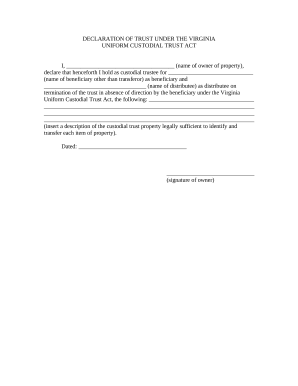
(5) Custodial trust property means an interest in property transferred to or held under a declaration of trust by a custodial trustee under this chapter and the income from and proceeds of that interest.
Code of Virginia Code - Chapter 7. Uniform Trust Code.
As a beneficiary in Virginia, you have several rights. At the most basic level, you are entitled to receive information about the estate and its administration. You also have a right to an accounting of the estates assets, debts, and distributions.