
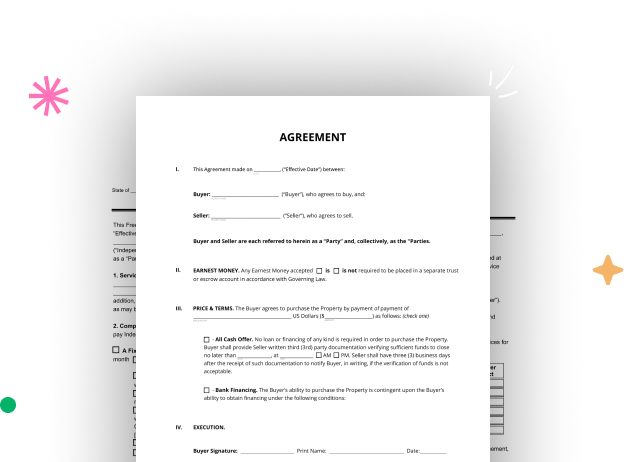


Create your Construction Sector Legal Form from scratch

Start Building Now
Title decoration

Here's how it works

01. Start with a blank Construction Sector Legal Form
Open the blank document in the editor, set the document view, and add extra pages if applicable.
02. Add and configure fillable fields
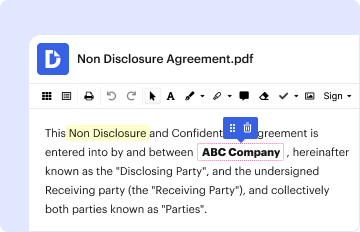
Use the top toolbar to insert fields like text and signature boxes, radio buttons, checkboxes, and more. Assign users to fields.
03. Distribute your form
Share your Construction Sector Legal Form in seconds via email or a link. You can also download it, export it, or print it out.

A detailed guide on how to build your Construction Sector Legal Form online

Form edit decoration

Step 1: Start with DocHub's free trial.

Visit the DocHub website and sign up for the free trial. This provides access to every feature you’ll need to build your Construction Sector Legal Form without any upfront cost.

Step 2: Navigate to your dashboard.

Sign in to your DocHub account and go to the dashboard.

Step 3: Craft a new document.

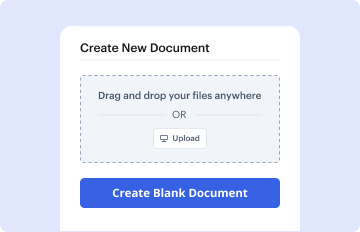
Click New Document in your dashboard, and choose Create Blank Document to create your Construction Sector Legal Form from the ground up.

Step 4: Use editing tools.

Add different elements such as text boxes, radio buttons, icons, signatures, etc. Arrange these elements to suit the layout of your document and assign them to recipients if needed.

Step 5: Modify the form layout.

Rearrange your document easily by adding, repositioning, removing, or merging pages with just a few clicks.

Step 6: Set up the Construction Sector Legal Form template.

Transform your freshly designed form into a template if you need to send many copies of the same document multiple times.

Step 7: Save, export, or distribute the form.

Send the form via email, distribute a public link, or even publish it online if you want to collect responses from more recipients.


be ready to get more

Build your Construction Sector Legal Form in minutes

Start creating now

Got questions?

We have answers to the most popular questions from our customers. If you can't find an answer to your question, please contact us.
Contact us
0:03 2:19 Form setter typically comes in after the steel men have installed their steel. And when they installMoreForm setter typically comes in after the steel men have installed their steel. And when they the steel its ready to pour but before that we have to come in the forms.
Formwork is the structure, usually temporary, used to contain poured concrete and to mould it to the required dimensions and support until it is able to support itself. It consists primarily of the face contact material and the bearers that directly support the face contact material.
The construction industry uses forms to collect and share information at every stage of a project. Traditionally on paper, these forms are now being converted into digital forms that enable workers to share information via mobile devices and tablets on the job.
Construction Forms means the notices and other information, in the form approved by WW from time to time, that an Accredited Contractor is required to lodge with WW to verify that Development Works have been constructed in ance with WWs requirements.
Limited liability companies are a popular choice among construction contractors because they provide protection to an owners personal assets. All customer or creditor claims against the company are limited to the assets owned by the business.
be ready to get more

Build your Construction Sector Legal Form in minutes

Start creating now

Related Q&A to Construction Sector Legal Form

There are five common types of construction contracts: lump sum (or fixed price), time and materials (TM), unit price, guaranteed maximum price (GMP), and cost-plus.
How to start a construction company Research the construction industry. Craft a business plan. Register your company. Acquire any necessary licenses, permits and certifications. Insure your company and employees. Secure funding. Organize a marketing strategy. Hire employees or contractors.
Construction documents are directions from the Architect to the Contractor. These documents describe precisely how the Contractor will make the Architects design become a built object - through drawings and specifications.

Additional resources on building your forms