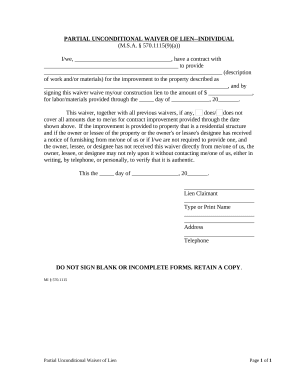
Manage Construction Law Forms quickly online

Document managing can overpower you when you can’t find all of the forms you need. Luckily, with DocHub's considerable form library, you can get everything you need and easily manage it without switching between apps. Get our Construction Law Forms and start utilizing them.

How to use our Construction Law Forms using these easy steps:

  1. Examine Construction Law Forms and select the form you need.
  2. Review the template and click Get Form.
  3. Wait for it to open in our online editor.
  4. Modify your template: include new information and pictures, and fillable fields or blackout some parts if necessary.
  5. Prepare your template, conserve changes, and prepare it for delivering.
  6. When you are ready, download your form or share it with other contributors.

Try out DocHub and browse our Construction Law Forms category easily. Get your free account today!

Video Guide on Construction Law Forms management

video background

Commonly Asked Questions about Construction Law Forms

Formwork is the structure, usually temporary, used to contain poured concrete and to mould it to the required dimensions and support until it is able to support itself. It consists primarily of the face contact material and the bearers that directly support the face contact material.
Formwork, also known as concrete forms, is a temporary or permanent mould used to create concrete slabs and structures. Its a barrier that holds the fresh concrete in place and helps with shaping the concrete until the concrete is strong enough to hold its own weight and shape.
At its core, a form is a tool for collecting and organizing information. It is a structured document with spaces allotted for entering data, whether its for administrative purposes, data gathering, or record-keeping. Forms have an awesome ability to standardize and streamline data collection.
There are five common types of construction contracts: lump sum (or fixed price), time and materials (TM), unit price, guaranteed maximum price (GMP), and cost-plus.
Form refers to the shape or configuration of a building. Form and its opposite, space, constitute primary elements of architecture. The reciprocal relationship is essential, given the intention of architecture to provide internal sheltered space for human occupation.