Improve your document operations with Construction Forms

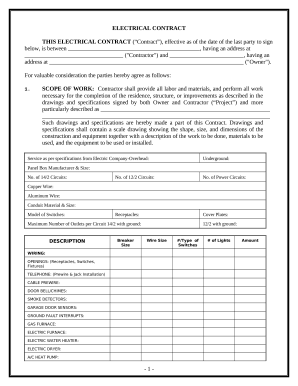
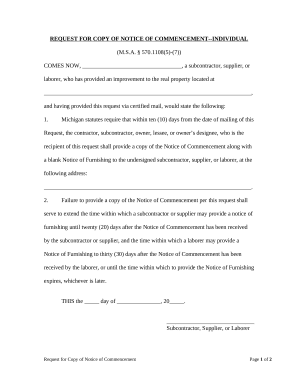
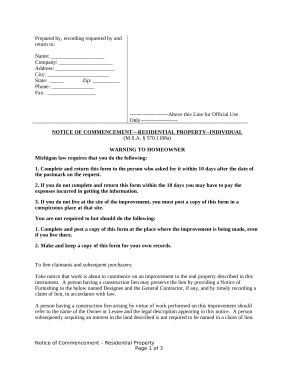
Your workflows always benefit when you can locate all of the forms and files you will need at your fingertips. DocHub offers a a huge collection of document templates to ease your daily pains. Get hold of Construction Forms category and easily discover your form.

Start working with Construction Forms in a few clicks:

  1. Gain access to Construction Forms and find the document you need.
  2. Click on Get Form to open it in our editor.
  3. Start adjusting your file: add fillable fields, highlight paragraphs, or blackout sensitive information and facts.
  4. The app saves your modifications automatically, and once you are ready, you can download or distribute your file with other contributors.

Enjoy effortless document managing with DocHub. Check out our Construction Forms category and discover your form right now!


Video Guide on Construction Forms management

video background

Commonly Asked Questions about Construction Forms

Lump sum contracts This is the most basic and common type of construction contract. Lump sum contracts work especially well for projects with a well-defined scope of work, which enables contractors to make an accurate estimate of the projects cost.
Formwork is the structure, usually temporary, used to contain poured concrete and to mould it to the required dimensions and support until it is able to support itself. It consists primarily of the face contact material and the bearers that directly support the face contact material.
Among the types of construction contracts mentioned above, the unit price, lump sum, fixed price, time and materials, and cost-plus contracts fall under the category of commercial contracts. An agreement between contractors and business owners is referred to as a commercial construction contract.
Construction Forms means the notices and other information, in the form approved by WW from time to time, that an Accredited Contractor is required to lodge with WW to verify that Development Works have been constructed in ance with WWs requirements.
Setting forms involves laying out the shape and height of the foundation effectively creating a mold for what will become the concrete foundation of the home.
Basic types of construction The four main types of construction are: residential construction, commercial construction, industrial construction, and infrastructure construction.
5 types of building construction Fire-resistive (Type I) High-rise residential and industrial structures are some of the buildings that compose the Type I construction variety. Non-combustible (Type II) Ordinary (Type III) Heavy timber (Type IV) Wood-framed (Type V)
Form refers to the shape or configuration of a building. Form and its opposite, space, constitute primary elements of architecture. The reciprocal relationship is essential, given the intention of architecture to provide internal sheltered space for human occupation.