


Create your Connecticut Real Estate Legal Document from scratch

Start Building Now
Title decoration

Here's how it works

01. Start with a blank Connecticut Real Estate Legal Document
Open the blank document in the editor, set the document view, and add extra pages if applicable.
02. Add and configure fillable fields
Use the top toolbar to insert fields like text and signature boxes, radio buttons, checkboxes, and more. Assign users to fields.
03. Distribute your form
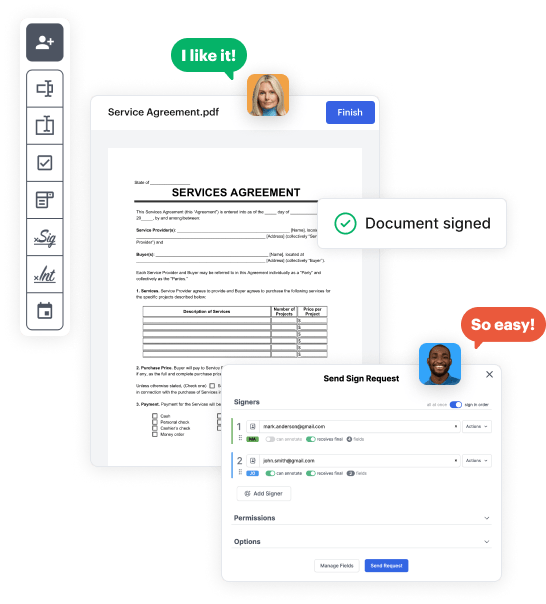
Share your Connecticut Real Estate Legal Document in seconds via email or a link. You can also download it, export it, or print it out.

Create your Connecticut Real Estate Legal Document in a matter of minutes

Form edit decoration

Step 1: Access DocHub to set up your Connecticut Real Estate Legal Document.

Begin by accessing your DocHub account. Utilize the pro DocHub functionality at no cost for 30 days.

Step 2: Navigate to the dashboard.

Once logged in, go to the DocHub dashboard. This is where you'll create your forms and manage your document workflow.

Step 3: Design the Connecticut Real Estate Legal Document.

Click on New Document and choose Create Blank Document to be redirected to the form builder.

Step 4: Set up the form layout.

Use the DocHub features to insert and configure form fields like text areas, signature boxes, images, and others to your document.

Step 5: Insert text and titles.

Add necessary text, such as questions or instructions, using the text tool to guide the users in your form.

Step 6: Customize field properties.

Adjust the properties of each field, such as making them required or formatting them according to the data you expect to collect. Assign recipients if applicable.

Step 7: Review and save.

After you’ve managed to design the Connecticut Real Estate Legal Document, make a final review of your document. Then, save the form within DocHub, transfer it to your chosen location, or distribute it via a link or email.


be ready to get more

Build your Connecticut Real Estate Legal Document in minutes

Start creating now

Got questions?

We have answers to the most popular questions from our customers. If you can't find an answer to your question, please contact us.
Contact us
A cash down payment is not an essential element of a valid real estate contract. Essential elements include competent parties, offer and acceptance, and consideration.
How to write a real estate purchase agreement. Identify the address of the property being purchased, including all required legal descriptions. Identify the names and addresses of both the buyer and the seller. Detail the price of the property and the terms of the purchase. Set the closing date and closing costs.
In Florida, a contract is established through a simple but vital process: offer, acceptance, and exchange of value (consideration). This means that a contract comes into existence when one party presents a clear offer, and the other party accepts it, coupled with an exchange of something of value.
Complete 60 Hours of Connecticut-Approved Real Estate Pre-Licensing Education. Submit Your Connecticut Real Estate License Application. Take Pass the Connecticut Real Estate Exam.
You Can Write the Contract Yourself In Florida, there is no legal requirement to hire an attorney (unlike in many other states), but a real estate attorney can make sure the details are covered completely and correctly, protecting your interests and finances in the process.
be ready to get more

Build your Connecticut Real Estate Legal Document in minutes

Start creating now

Related Q&A to Connecticut Real Estate Legal Document

FSBO contracts in Florida should include the following: Contract Title: Details of Seller and Buyer: Full names, marital status and contact information. Contract Date: The date of execution. Property Details: Payment terms: Real Estate Taxes: Detail who pays real estate taxes and how.
In the state of Florida, all real estate contracts must be made in writing and must contain certain relevant information in order to be valid and legally binding. Required information includes the identification of all parties, the legal description and address of the property, and the purchase price.
In Connecticut, there are only two circumstances in which a seller can back out of a real estate contract: the buyer does not meet the contingencies in the contract or the buyer bdocHubes the contract.


