


Increase your production with Company Operating Agreements

Record management takes up to half of your office hours. With DocHub, it is simple to reclaim your time and effort and enhance your team's productivity. Get Company Operating Agreements category and explore all form templates relevant to your daily workflows.

Effortlessly use Company Operating Agreements:

  1. Open Company Operating Agreements and apply Preview to get the suitable form.
  2. Click Get Form to begin working on it.
  3. Wait for your form to open in our online editor and start modifying it.
  4. Add new fillable fields, icons, and pictures, modify pages order, and many more.
  5. Fill your form or prepare it for other contributors.
  6. Download or share the form by link, email attachment, or invite.

Improve your daily document management with the Company Operating Agreements. Get your free DocHub profile today to explore all forms.


Video Guide on Company Operating Agreements management

video background

Commonly Asked Questions about Company Operating Agreements

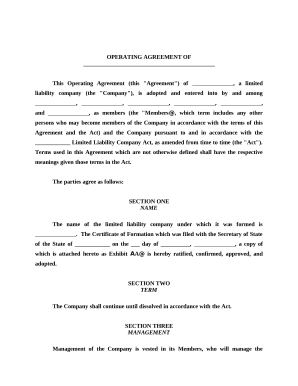
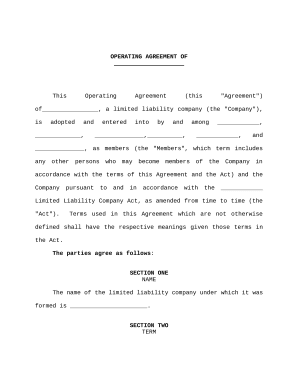
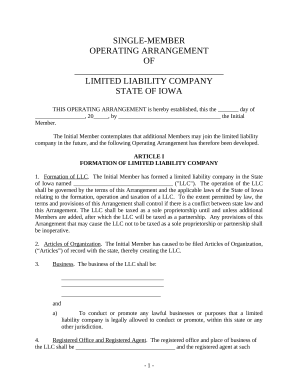
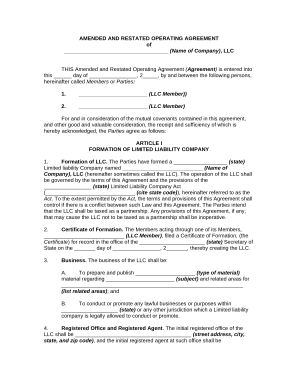
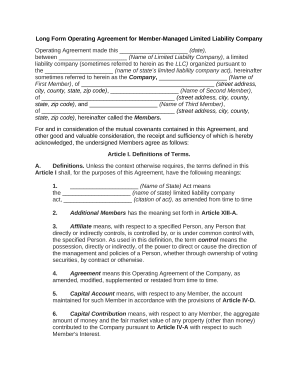
An operating agreement should include the following: Percentage of members ownership. Meeting provisions and voting rights. Powers and duties of members and management. Distribution of profits and losses. Tax treatment preference. A liability statement. Management structure. Operating procedures. How to Write an Operating Agreement (Step-by-Step) - OnBoard onboardmeetings.com blog operating-ag onboardmeetings.com blog operating-ag
Similarly, corporations (S corps and C corps) are not legally required by any state to have an operating agreement. Still, experts advise owners of these businesses to create and execute their version of an operating agreement, called bylaws.
The operating agreement is thus a document that spells out the terms of a limited liability company (LLC) ing to the members. It sets forth the path for the business to follow and brings in more clarity in operations and management. LLC Operating Agreement: Definition, Purpose, Format, Importance investopedia.com terms llc-operating-agr investopedia.com terms llc-operating-agr
Operating agreements can also provide financial benefits. An operating agreement draws a clear line between the company and its members, which can clarify their protection from personal liability for company debts. It can also detail how the company will be taxed.
In addition to protecting against personal liability and State default rules, operating agreements also protect members against one another. While you may not foresee future disagreements with your fellow members, there is a high likelihood that they will occur at some point.
An operating agreement should include the following: Percentage of members ownership. Meeting provisions and voting rights. Powers and duties of members and management. Distribution of profits and losses. Tax treatment preference. A liability statement. Management structure. Operating procedures.
An operating or business operating account is an essential financial tool for companies of all sizes. Its main purpose is to manage the daily transactions that businesses undertake, like paying bills, receiving payments from customers, reimbursing employees for expenses, and handling payroll. Operating Accounts - Does Your Business Need One? | Expensify expensify.com resource-center guides s expensify.com resource-center guides s
How to Write an Operating Agreement Step by Step Step One: Determine Ownership Percentages. Step Two: Designate Rights, Responsibilities, and Compensation Details. Step Three: Define Terms of Joining or Leaving the LLC. Step Four: Create Dissolution Terms. Step Five: Insert a Severability Clause.
The LLC operating agreement, also known as an LLC agreement, establishes the rules and structure for the LLC and can help address any issues that arise during business operations. Most states have default provisions that address many of these difficulties, but the operating agreement can override these presumptions.
Operating Agreement vs. A business plan sets out company goals along a timeline and is more of a roadmap that gives an indication to the members and others (lenders, for example) of where the company is going and how it will theoretically get there.
