
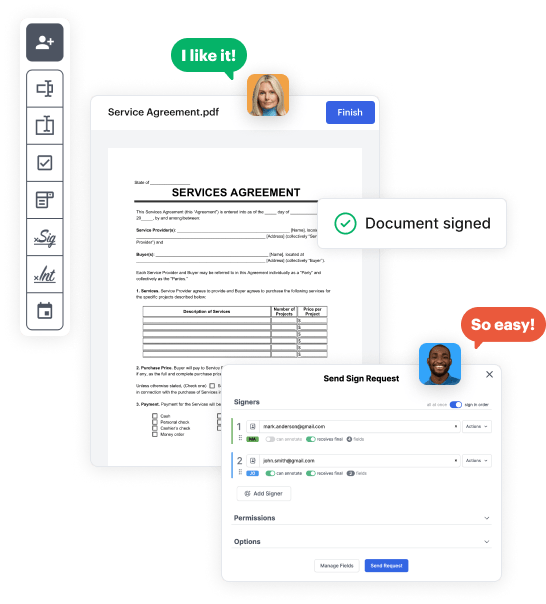
Create your Commercial Property Legal Document from scratch

Start Building Now
Title decoration

Here's how it works

01. Start with a blank Commercial Property Legal Document
Open the blank document in the editor, set the document view, and add extra pages if applicable.
02. Add and configure fillable fields
Use the top toolbar to insert fields like text and signature boxes, radio buttons, checkboxes, and more. Assign users to fields.
03. Distribute your form
Share your Commercial Property Legal Document in seconds via email or a link. You can also download it, export it, or print it out.

A brief guide on how to set up a polished Commercial Property Legal Document

Form edit decoration

Step 1: Sign in to DocHub to begin creating your Commercial Property Legal Document.

First, log in to your DocHub account. If you don't have one, you can easily register for free.

Step 2: Head to the dashboard.

Once logged in, access your dashboard. This is your primary hub for all document-based tasks.

Step 3: Start new document creation.

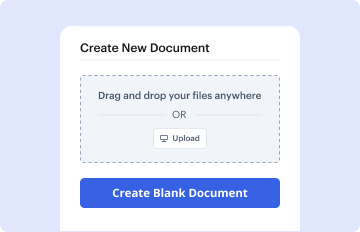
In your dashboard, choose New Document in the upper left corner. Pick Create Blank Document to craft the Commercial Property Legal Document from scratch.

Step 4: Incorporate form elements.

Place various items like text boxes, photos, signature fields, and other fields to your form and assign these fields to intended users as required.

Step 5: Personalize your document.

Personalize your form by inserting directions or any other necessary tips leveraging the text feature.

Step 6: Double-check and adjust the document.

Carefully examine your created Commercial Property Legal Document for any discrepancies or necessary adjustments. Utilize DocHub's editing features to polish your document.

Step 7: Send out or download the document.

After finalizing, save your copy. You may select to keep it within DocHub, transfer it to various storage services, or send it via a link or email.


be ready to get more

Build your Commercial Property Legal Document in minutes

Start creating now

Got questions?

We have answers to the most popular questions from our customers. If you can't find an answer to your question, please contact us.
Contact us
How to Write an LOI in Commercial Real Estate Structure it like a letter. Write the opening paragraph. State the parties involved. Draft a property description. Outline the terms of the offer. Include disclaimers. Conclude with a closing statement.
📊 The data: Our December 2023 survey of local agents found that the average real estate commission in New York is 5.39%, which is less than the national average of 5.49%. Calculate your estimated commission in New York.
Commercial security deposits are not just supposed to go into a landlords bank account. They should be in a separate, interest-bearing account that a tenant is made aware of. The interest gained, minus a one-percent fee, can be given to the tenant or used to pay rent.
The amount depends on the length of the lease, the location, and the broker. The percentage usually varies over the course of the lease (e.g. for a five-year lease, the broker could be paid 5% of the first years base rent, and 4% for the second through fifth years).
The AIR forms are designed to keep the transaction moving. The s allow the buyer more time to inspect, perform, or extend the closing date. Often, it is also more likely the buyer can get the deposit refunded if a is used. The primary difference between the AIR and s are passive vs.
be ready to get more

Build your Commercial Property Legal Document in minutes

Start creating now

Related Q&A to Commercial Property Legal Document

When it comes to leases, the commission is usually a percentage of the revenue of the initial lease term. For example, if a building is leased for $5,000 per month on a 3-year lease, it generates the building owner $180,000 in revenue. If the negotiated commission is 5%, the broker gets $9,000 (=$180,0000.05).

Additional resources on building your forms


