
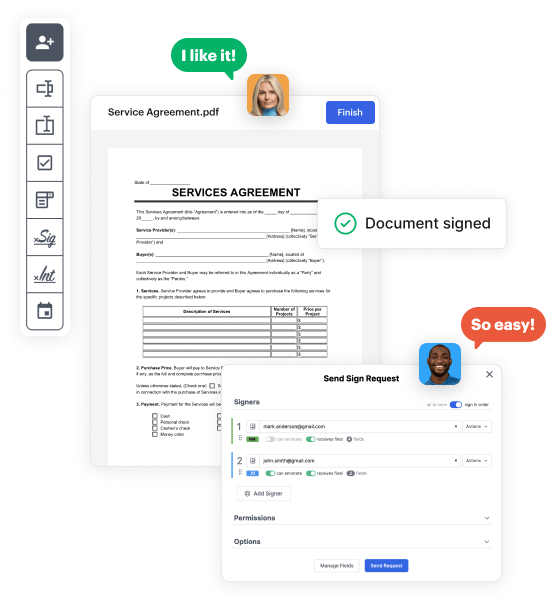
Create your Business Accounting Form from scratch

Start Building Now
Title decoration

Here's how it works

01. Start with a blank Business Accounting Form
Open the blank document in the editor, set the document view, and add extra pages if applicable.
02. Add and configure fillable fields
Use the top toolbar to insert fields like text and signature boxes, radio buttons, checkboxes, and more. Assign users to fields.
03. Distribute your form
Share your Business Accounting Form in seconds via email or a link. You can also download it, export it, or print it out.

A detailed guide on how to build your Business Accounting Form online

Form edit decoration

Step 1: Start with DocHub's free trial.

Navigate to the DocHub website and register for the free trial. This provides access to every feature you’ll require to create your Business Accounting Form without any upfront cost.

Step 2: Access your dashboard.

Log in to your DocHub account and go to the dashboard.

Step 3: Craft a new document.

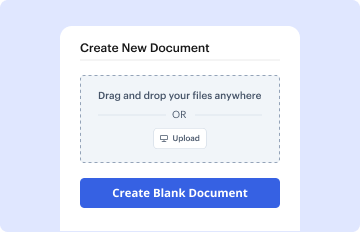
Hit New Document in your dashboard, and select Create Blank Document to craft your Business Accounting Form from scratch.

Step 4: Utilize editing tools.

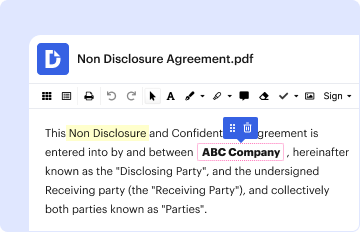
Place different fields such as text boxes, radio buttons, icons, signatures, etc. Arrange these fields to match the layout of your form and designate them to recipients if needed.

Step 5: Organize the form layout.

Organize your form quickly by adding, moving, deleting, or combining pages with just a few clicks.

Step 6: Craft the Business Accounting Form template.

Transform your newly designed form into a template if you need to send many copies of the same document repeatedly.

Step 7: Save, export, or share the form.

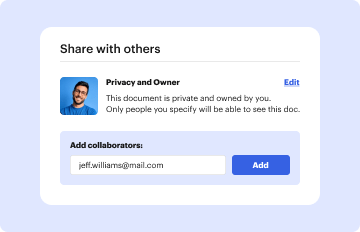
Send the form via email, share a public link, or even publish it online if you aim to collect responses from more recipients.


be ready to get more

Build your Business Accounting Form in minutes

Start creating now

Got questions?

We have answers to the most popular questions from our customers. If you can't find an answer to your question, please contact us.
Contact us
A manual accounting system keeps financial records by hand rather than on a computer. These systems may still be common in small businesses that have few transactions and simple finances. Typically, you enter transactions into a paper spreadsheet or a ledger, using a calculator to do any calculations.
How to do bookkeeping for small businesses: A step-by-step guide Gather your financial documents. Categorize your business transactions. Reconcile your business transactions. Prepare your businesss financial statements. Review your financial statements.
9 Steps To Build a Startup Bookkeeping System Choose either cash or accrual accounting method. Open a business bank account. Set up accounting software. Connect a payment collection system. Set up a payroll system. Begin regular bank reconciliation. Build key reports. Establish a company expense policy.
7 Steps To Be Your Own Accountant Learn the Basics of Accounting. Open a Business Bank Account. Establish a Bookkeeping System. Categorize Your Expenses. Establish a Budget. Use Accounting Software for Invoicing and Payroll. Paying Your Taxes.
Some will choose to simply hire an accountant to save time, but doing your accounting can provide you with more control. Some also find this to be a rewarding process. The results are in: 72% of self-employed people do their own accounting.
be ready to get more

Build your Business Accounting Form in minutes

Start creating now

Related Q&A to Business Accounting Form

Accrual basis accounting records those invoices and bills even if the funds havent been exchanged. Generally, accrual basis is the recommended accounting method and more aligned with generally accepted accounting principles.
Follow these steps: Step 1: Pick the balance sheet date. Step 2: List all of your assets. Step 3: Add up all of your assets. Step 4: Determine current liabilities. Step 5: Calculate long-term liabilities. Step 6: Add up liabilities. Step 7: Calculate owners equity. Step 8: Add up liabilities and owners equity.
Manual accounting is the accounting method that uses registers, journals, ledgers, and other physical account books to record financial transactions. Though medium and large-sized businesses have started using accounting software, many small and single-owner companies still maintain their accounts manually.

Additional resources on building your forms