



Create your Arizona Law Form from scratch

Start Building Now
Title decoration

Here's how it works

01. Start with a blank Arizona Law Form
Open the blank document in the editor, set the document view, and add extra pages if applicable.
02. Add and configure fillable fields
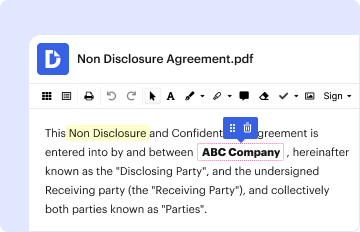
Use the top toolbar to insert fields like text and signature boxes, radio buttons, checkboxes, and more. Assign users to fields.
03. Distribute your form
Share your Arizona Law Form in seconds via email or a link. You can also download it, export it, or print it out.

A simple tutorial on how to set up a polished Arizona Law Form

Form edit decoration

Step 1: Log in to DocHub to create your Arizona Law Form.

First, sign in to your DocHub account. If you don't have one, you can simply register for free.

Step 2: Head to the dashboard.

Once logged in, access your dashboard. This is your primary hub for all document-related operations.

Step 3: Initiate new document creation.

In your dashboard, click on New Document in the upper left corner. Opt for Create Blank Document to craft the Arizona Law Form from a blank slate.

Step 4: Insert template fillable areas.

Place various items like text boxes, photos, signature fields, and other fields to your template and assign these fields to specific users as needed.

Step 5: Personalize your form.

Refine your document by incorporating guidelines or any other crucial information utilizing the text tool.

Step 6: Go over and correct the form.

Thoroughly review your created Arizona Law Form for any typos or essential adjustments. Make use of DocHub's editing features to polish your form.

Step 7: Send out or export the form.

After completing, save your file. You may choose to keep it within DocHub, export it to various storage solutions, or forward it via a link or email.


be ready to get more

Build your Arizona Law Form in minutes

Start creating now

Got questions?

We have answers to the most popular questions from our customers. If you can't find an answer to your question, please contact us.
Contact us
Motions may be made orally in open court or by filing and serving the opposing party with a copy of a written motion. Pretrial motions shall be ruled on before trial. A court shall not rule on any motion until the opposing party has had a reasonable opportunity to respond.
The Order, or proposed order is an optional step in the motion process. You may fill out the Order form using your proposed language. This option requires you to provide pre-addressed, stamped envelopes for yourself and the other party. The Judge may then sign your proposed order and send a copy using your envelopes.
Go to the Clerk of Superior Court and ask to file a Petition to Establish Legal Decision-Making (legal custody), Parenting Time and Child Support. They will give you a packet of forms which you need to fill out. (This packet is also downloadable online.) File your completed paperwork and pay the required filing fees.
Every county in Arizona has justice courts. Justice courts are the limited jurisdiction courts which handle misdemeanor crimes, protective orders, small claims up to $3,500, and civil lawsuits for amounts of $10,000 and below. Appeals from justice court go to the county superior court.
Filing Fees CivilCurrent Fees Civil Complaint and Summons $101.00 Answer to Civil Complaint $68.00 Small Claims Small Claims Complaint $53.0016 more rows
be ready to get more

Build your Arizona Law Form in minutes

Start creating now

Related Q&A to Arizona Law Form

A civil action filed in a limited jurisdiction court is a claim against another party for damages of an amount up to $10,000.00.
Arizona Civil Statute of Limitations Laws: At a Glance Injury to PersonOne year for false imprisonment (A.R.S. 12-541) Two years for personal injury (A.R.S. 12-542) Libel/Slander One year (A.R.S. 12-541) Fraud Three years (A.R.S. 12-543(3)) Injury to Personal Property Two years (A.R.S. 12-542)6 more rows
Every county in Arizona has at least two justice courts. The justice courts have exclusive authority to hear cases in which the amount in controversy is $10,000 or less. Cases in which the amount in controversy is greater than $10,000 must be filed in the superior court.

Additional resources on building your forms


