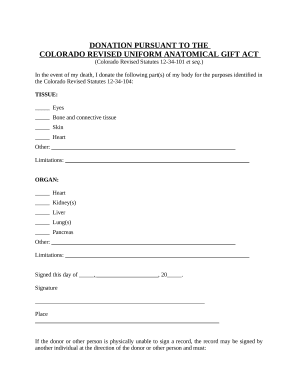
Improve your production with Anatomical Gift Act Donation Forms

Record management consumes to half of your office hours. With DocHub, it is simple to reclaim your office time and enhance your team's efficiency. Access Anatomical Gift Act Donation Forms online library and investigate all form templates related to your everyday workflows.

Effortlessly use Anatomical Gift Act Donation Forms:

  1. Open Anatomical Gift Act Donation Forms and apply Preview to find the suitable form.
  2. Click on Get Form to begin working on it.
  3. Wait for your form to upload in the online editor and start editing it.
  4. Add new fillable fields, icons, and images, change pages order, etc.
  5. Fill out your template or prepare it for other contributors.
  6. Download or share the form by link, email attachment, or invite.

Boost your everyday document management with our Anatomical Gift Act Donation Forms. Get your free DocHub account right now to explore all templates.


Video Guide on Anatomical Gift Act Donation Forms management

video background

Commonly Asked Questions about Anatomical Gift Act Donation Forms

Originally enacted in 1968, the Uniform Anatomical Gift Act is a federal framework that sets how anatomical gifts can be made. Every state has enacted the provisions of the act in some form.
The act eliminates the specific bar on post-mortem donations by someone who knows the decedent refused to donate. Instead, it bars anyone, other than the parents of a deceased minor, from making a donation if the donor refused in writing to donate and did not revoke this refusal or expressly indicate otherwise.
Introduction. Organ and tissue donation occurs after a person has died. Transplantable organs and tissue can be donated to help the lives of individuals in need. Anatomical gift means a donation of all or part of a human body, after death, for the purpose of transplantation, therapy, research or education. Get the Facts | Organ/Tissue Donation and Registry Missouri Department of Health and Senior Services - MO.gov living organdonor facts Missouri Department of Health and Senior Services - MO.gov living organdonor facts
Gift Law Governs Anatomical Donations Gift law requires three elements: intent, transfer and acceptance. As such, the donation gift is a voluntary, legally binding, uncompensated transfer from one individual to another. Legal Aspects of a Registered Donor The Organ Donation and Transplantation Alliance insight legal-a The Organ Donation and Transplantation Alliance insight legal-a
After donation, the donor is taken to a funeral home, and the OPO works with the funeral director to honor the donor and donor familys funeral wishes. An open casket funeral is possible after organ donation. Deceased Organ Donation Process - UNOS UNOS transplant deceased-donation UNOS transplant deceased-donation
(2) Declaration means a record signed by a prospective donor specifying the circumstances under which a life-support system may be withheld or withdrawn from the prospective donor. (3) Health care decision means any decision made regarding the health care of the prospective donor.
The UAGA of 2006 allows for individuals to consent to organ donation by expressing their wish when obtaining a drivers license, through verbal expression, by writing it in a will or other advance directive, or in any other manner, simplifying the consent process. This is also known as opting in to organ donation. Uniform Anatomical Gift Act - Wikipedia Wikipedia wiki UniformAnatomicalG Wikipedia wiki UniformAnatomicalG