Enhance your template operations with Federal court Complaint Forms

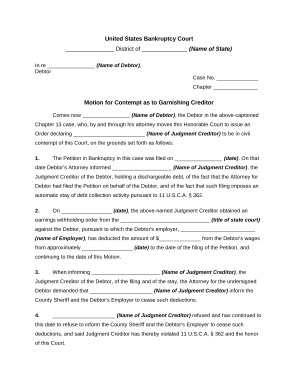
Your workflows always benefit when you can easily locate all the forms and files you will need at your fingertips. DocHub delivers a a large collection form templates to ease your day-to-day pains. Get a hold of Federal court Complaint Forms category and quickly browse for your document.

Start working with Federal court Complaint Forms in several clicks:

  1. Access Federal court Complaint Forms and discover the document you require.
  2. Click on Get Form to open it in the editor.
  3. Begin changing your file: add more fillable fields, highlight paragraphs, or blackout sensitive information.
  4. The application saves your adjustments automatically, and once you are all set, you can download or share your file with other contributors.

Enjoy fast and easy form managing with DocHub. Check out our Federal court Complaint Forms collection and find your form right now!


Video Guide on Federal court Complaint Forms management

video background

Commonly Asked Questions about Federal court Complaint Forms

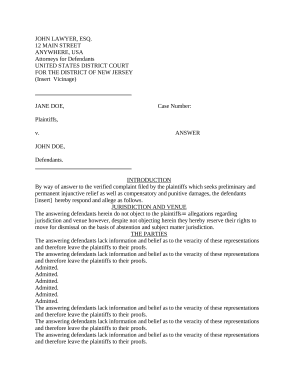
The very first thing you need to do is to determine when your response is due. Always check your courts local rules as well as the Federal Rules of Civil Procedure. Generally, a party served with a complaint must respond within 21 days after being served. See Fed.
For each paragraph in the complaint, state whether: the defendant admits the allegations in that paragraph; denies the allegations; lacks sufficient knowledge to admit or deny the allegations; or admits certain allegations but denies, or lacks sufficient knowledge to admit or deny, the rest.
A verified complaint has a statement at the very end of the complaint, after the attorneys signature (or the plaintiffs signature if there is no attorney), that is signed under penalty of perjury stating that the statements in the complaint are true.
State briefly and precisely what damages or other relief the plaintiff asks the court to order. Do not make legal arguments. Include any basis for claiming that the wrongs alleged are continuing at the present time. Include the amounts of any actual damages claimed for the acts alleged and the basis for these amounts.
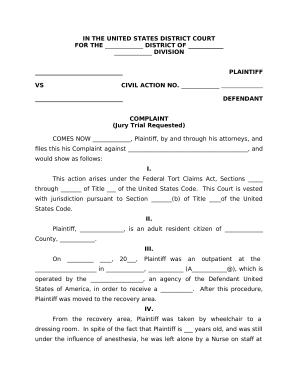
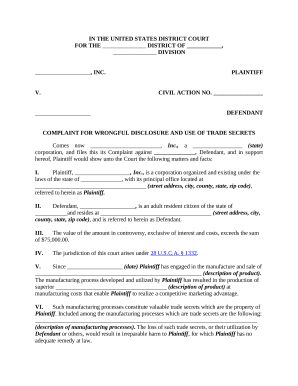
Federal civil cases begin with the filing of a complaint. The plaintiff(s) claim that the defendant(s) failed to carry out some type of legal duty (for example, the duty to comply with a contract or the duty not to violate constitutional rights).
State as briefly as possible the facts showing that each plaintiff is entitled to the injunction or other relief sought. State how each defendant was involved and what each defendant did that caused the plaintiff harm or violated the plaintiffs rights, including the dates and places of that involvement or conduct.
File an answer Filing an answer is probably the most common way of responding to a lawsuit. An answer is your opportunity to respond to the complaints factual allegations and legal claims. It also allows you to assert affirmative defenses, facts or legal arguments you raise to defeat plaintiffs claim.